ESG-Goals
Focus Areas, Material Topics, Targets and KPIs
Within the framework of its four strategic focus areas, Metall Zug considers ten specific topics to be material, and sets quantitative targets wherever appropriate and possible. The table below shows the defined topics and associated targets:
| Focus Topics | |||
| Climate & Resources | Employees | Products & Services
| Society & Value Creation |
| Material Topics | |||
Energy efficiency & reduction of greenhouse gas emissions
Resource efficiency | Employee motivation and development
Occupational health and safety
Diversity and equal opportunities | Safe, and high-quality products & services Innovative and resource-efficient products & services
Responsible procurement | Corporate Governance Social engagement and regional contribution |
| Targets and Initiatives | |||
Metall Zug will achieve the goal of net-zero emissions in Scope 1 and 2 by 2050 thanks to its own efforts and effective, good-quality reduction certificates
Awareness is being raised by taking account of the “climate cost” in investment/business decisions: CO₂ emissions are allocated a price at Metall Zug
The Group’s internal CO₂ levy in the Greenhouse Gas Fund is used for innovative and effective projects to avoid greenhouse gas emissions and promote the circular economy
The Group supports systemic approaches for a transformation toward a climate-friendly economy | Operate with a human-centered approach
Internal development of managers and skilled workers
Increase and preserve employee satisfaction
Reduction of occupational accidents
Promoting equality and equal opportunities | Expansion of product durability, reparability and circularity
Utilize multi-use & renewable packaging materials
Effective improvements in the supply chain | Creation of a range of affordable housing
Protection of the company’s integrity
Creation and retention of local jobs
Contribution to high-quality location development
Strong commitment to Zug as a location and Switzerland as a place for manufacturing |
| KPIs | |||
Reduction of greenhouse gas emissions from heating and operating energy, vehicles, and business air travel TIncrease in the proportion of renewable heating and operating energy
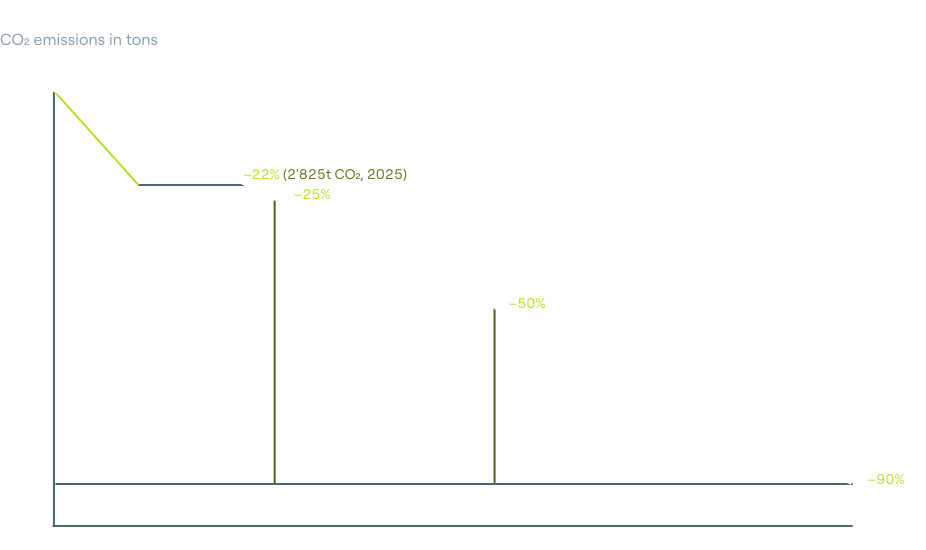
Absolute CO₂ reduction in Scope 1 and 2 of –25 % by 2030 and –50 % by 2040 compared to the base year 2022
| Proportion of apprentices/trainees: >5%
Investment in training and continuing professional development: >1% of gross payroll
Management positions filled with internal employees: >40%
Increase in employee satisfaction
Reduction in the number of occupational accidents and days of absence
A gender ratio in management positions that corresponds to the average gender ratio in management positions in the most important Swiss companies | Life cycle assessments for top sellers Increase in the proportion of service and retrofit activities Packaging material >90% from renewable materials | Annual employee training sessions on the Code of Conduct and cyber security
Creation of jobs at sites with development potential |
CO2 reduction path
The Metall Zug Group’s sustainability strategy was used to define quantitative goals that are comparable with the Swiss climate goals. 2022 was chosen as the base year at the Metall Zug Group for reasons of data availability and quality.
In Phase 1 (2022–2030), investments will be made in alternative energy concepts and resource-saving processes at our own sites as well as in our own service fleet. This includes installing photovoltaic systems, and part of our service fleet is to be electrified. The measures implemented to date are having a positive effect, as we have already been able to reduce our CO2 emissions by 20% in the past two years. In Phase 2 (2030–2040), the purchase of renewable electricity will be extended to more sites, additional building measures – such as efficient HVAC systems – will be implemented, and the electrification of the service fleet will continue. In Phase 3 (2040– 2050), the aim is for every site to be supplied with renewable electricity. At sites that still rely on natural gas, biogas or climate-neutral synthetic gas should be used. Further measures are being continuously evaluated based on technological progress. The goal for Phases 1–3 up to 2050 is to reduce emissions by 90% in comparison with the base year of 2022. Phase 4 will begin as of 2050. From this point on, a maximum of 10% of the remaining CO2 emissions are to be offset by high-quality CO2 certificates based on absorption and innovative carbon capture technologies.
Phase 1
Investments in our sites:
Photovoltaic systems at our own sites for green electricity production
Investments in more efficient, resource-saving production processes
Use a more fuel-efficient service fleet (electrify)
Purchase of renewable electricity at additional sites
Phase 2
Develop a more fuel-efficient service fleet
Expand the purchase of renewable electricity to additional sites
Further measures at (own) properties (e.g., HVAC systems)
Phase 3
Purchase of renewable electricity at all sites
Use of 100% biogas at sites
Phase 4
Maximum 10% high-quality CO₂ absorption certificates and use of new carbon capture technologies
Metall Zug is aware that a significant proportion of emissions arise in the upstream and downstream supply chains. The company is therefore planning to gradually build up a database in future that will record other Scope 3 emissions in addition to business flights and to report on it. As soon as we have enough good-quality data with regard to Scope 3 emissions, Metall Zug will also create a reduction path for Scope 3 emissions.